Sunday, May 6, 2012

Notes From Leogane: 22A Worship Service Paroisse Ste. Croix
Dear Family and Friends:
Pere Kerwin allowed me the opportunity to video various parts of today's Sunday service at Pariosse Sainte Croix, the Episcopal Church next door.
Keep in mind, this service was held without any choirs is attendance. All of the singing recorded today was by the congregation. I think we have a lot to learn.
I'll let the videos from today's 8:00 - 10:20 a.m. service speak, and sing for themselves as Notes From Leogane No. 22, with just brief commentary. This video is from an early part of the service, before the Gospel reading.
I hope this email and the later sent emails with videos attached find you and your loved ones in good health and spirits.
Peace,
David
Pere Kerwin allowed me the opportunity to video various parts of today's Sunday service at Pariosse Sainte Croix, the Episcopal Church next door.
Keep in mind, this service was held without any choirs is attendance. All of the singing recorded today was by the congregation. I think we have a lot to learn.
I'll let the videos from today's 8:00 - 10:20 a.m. service speak, and sing for themselves as Notes From Leogane No. 22, with just brief commentary. This video is from an early part of the service, before the Gospel reading.
I hope this email and the later sent emails with videos attached find you and your loved ones in good health and spirits.
Peace,
David
Note 22L
The video of Pere Kerwin speaking during the community
meeting / announcements also is too long for attachment, but then again he is
not singing.
Please keep in mind this Sunday service did not have any of the choirs participating. If they had been - Wow !
I hope hits last part of Note No. 22 finds you and your loved ones in good health and spirits.
Peace,
David
06 May 2012
Wednesday, May 2, 2012
Notes From Leogane No. 21: Street Beats and Rhythms and Leaving the Tourist Behind
“My eyes take in the view.
Poverty in all her glory . . .
Burning tires and
refuse,
Piled trash
along the roads,
Garbage
rivers running through the sewage bordered streets
But it’s not these
sights that register; my heart is blind to this . . .
My hand reaches out and I touch
Dirt, grit and grime
As I feel
palpable humidity and sweat trickling down
Creating muddy
tracks
That end in
sticky pods on my skin
But these textures
make no impression;
My heart can’t feel these things
These things can’t
touch and grasp the Haiti in my heart ! .
. .
Instead . . .
My heart sees . . . Beauty . . .
Lush vegetation
and trees,
on mountains with
flowers by the sea
The sun’s blazing orb
Casting light
upon a darkened world
Reflecting the vivid colors of Haiti –
Intense yellows,
orange, blues, red, pink . . .
And . . . children
Being loved by their mothers
or playing near
streets
Children . . . in starched uniforms
(the colors of Haiti)
Walking to and from school
. . .
Smiling . . .
Laughing . . .
My heart also hears . . . Music
The music of street merchants selling their wares
“Pee-stoch”
“D’lo”
And bartering
in rapid fire Kreyol . . .
Snorts,
laughs, loud guffaws . . .
And children singing is Haiti . . .
I sense an indomitable spirit
Their pride
Their joy . . .
(From Haiti in my
Heart by Cryssa C; an American who
with her husband has adopted seven of their thirteen children from the Foyer de
Simia orphanage in Haiti
I do not share this view of
everyday life in Haiti. I’m not able to
ignore the many problems and challenges here. I see where there is dirt and grime. There is nothing glorious, magical or uplifting about the abject poverty
you can encounter every day when venturing off the beaten path or down the
street a pace for that matter. I surely
don’t subscribe to the notion that Haitians facing hard times will nonetheless be “happy and joyful people.”
There are many angry young men
around Leogane, Port-au-Prince and elsewhere who internally, and sometimes
outwardly, plead for a job. Profane,
political graffiti on buildings underscores the anger.
For me, the death toll from cholera
the past two years – most probably visited upon Haitians from a Nepalese UN
troop source – should not stir someone to use this occasion to celebrate a
people’s resilience. I don’t see where
there is beauty in someone experiencing heartache. It is one thing to admire the grit of others. But why elevate that admiration to a new
level by suggesting that difficult times present well needed occasions for
personal growth. Such times often bring
death, particularly among the young.
Last year, I found myself in the
camp of those well-meaning folks, such as the author of the poem above, I now
criticize. Their sentiments at times
found their way into last year’s Notes. This year I continue in my admiration for many of the Haitians I have
met in Leogane, but not because they suffer so well. No, it’s because they have reminded me of the
importance of nurturing relationships, and about living. Life is teeming here.
 |
| 695 |
 |
| 700 |
 |
| 702 |
I do agree with at least one of the
poem’s sentiments, that watching school children on their way to school is
uplifting. I look forward to the parade
of solids, stripes and checker-board patterns outside my window every school day. (I’ve attached just a few photographs of student
comings and goings from last week, 0695, 0700, 0702, 0717 and 0721) I agree that the variety of uniform hues
might suggest an alternative way of viewing “the national colors of Haiti”, rather
than just the red and blue of the official flag.
 |
| 717 |
 |
| 721 |
Street Beats and Rhythms
There
are definite patterns and sounds to living in Leogane; some man-made, others
not. Weather fluctuates between bright
sun and high humidity, and cool air that follows a thumping rain. I don’t think the rain brings the same level
of noise one-half mile away in the sugar fields. But here, it beats down on the corrugated
metal roof of a ramada that was placed below my office window during the
renovation project. (Rain photo from
yesterday – 0727) This roof, half a
story down, serves as somewhat of a safety net Dr. Livingston, who continues to
go out on to the 5” wide ledge outside my window. (Dr. L. on the ledge
 |
| 727 |
 |
| 729 |
yesterday, photo
0729) I guess he has forgotten falling from
the second floor to the ground when he was six months old, while stretching out
on the same ledge. He’s lucky though, he
only has to survive the dangers of his street-watching roost until August when
Missy Owen is moving back to North Carolina after being here for more than two
years. She’s taking Dr. L with her.
It’s
good that he won’t be here next Christmas or Easter. Missy told me a few weeks ago that these are
cat-eating holidays. Poor Jackson. He owns a pharmacie across the street and is
one of Missy’s next door neighbors. In January,
Missy helped Jackson by de-worming his cat. Jackson thanked her; maybe the cat didn’t. He went missing Easter weekend; the cat, not
Jackson. I wonder how attractive a worm-invested cat would have been to Haitian feline carnivores.
Motos
infuse the streets with tinny noises. Their beeps can be a warning that the moto is turning a corner or that
it is approaching from behind – so keep walking a straight line or just stop in
place. But doing the latter will surely
delay the arrival at your destination, because motos are ubiquitous to the
streets of Leogane.
Sometimes the annoying sound signals
a non-verbal tirade directed to a truck or tap-tap that is hogging the road. Whatever the purpose, these beeps ebb and
flow during the day. They fill the
morning around 7:30 a.m., as many motos are driven by parents or older brothers
ferrying students to school. Last week,
I saw five on a moto – father driving, the youngest child in front sitting on
the fuel tank, and three children on the back. I don’t see many five occupant motos drive by,
but plenty with three or four. Moto sounds again dominate the street around
1:00 p.m., as the work day is at full throttle and children are returning from
school. Traffic picks up again after 5:00
p.m.
Moto horn symphonies reach full crescendo
on Saturdays - market day. On Samdi, ferried
school children are replaced by adults sitting behind the driver, holding on to
large bags of rice, beans, charcoal, and other assorted items bought at
market. Cargo may also be placed in
front of the driver. Only the laws of
physics seem to control the size of a load. Lumber or rebar may be toted, adding 2-3 feet of clearance that people
on foot must cede to an approaching moto driver. Many times, the passenger is using the moto
as a taxi. It usually costs 25 Gourdes
(about 60 cents U.S.) to catch a moto for a one-way in-town ride.
On Saturdays, open markets are
filled with a wide assortment of wares, clothing, shoes, CD’s, DVD’s, hair and beauty products and mangoes, mangoes
and more mangoes. (I’m told that there
are more than twenty kinds of mangoes.)
Every day tap taps and buses hit
the road from early morning through evening. On Friday afternoon, starting around 3 p.m., people leave the “bus
depot” in Leogane for Port-au-Prince where many who work in Leogane Monday
through Friday spend the weekend with their families in the capital city. Monday morning brings a reverse migration
from PaP back to Leogane. Dr. Samuels,
the ER doctor at the hospital, is one of the many Leoagne – PaP roundtrip weekend
travelers.
Last year, the “bus depot” in
Leogane City Center was where Grand Rue (one block north of the hospital) meets
the main highway going to PaP. I walked
by it several times last year. It always
was busy. The first weekend I was back this
year, there were only a few tap taps there at a time when I expected at least ten
vehicles in formation to be filled with passengers paying 50 Gourdes to get to
PaP, Jacmel, Les Cayes or elsewhere. The next day I happened to mention the
scarcity of vehicles to Mario. He told
me that the Leogane City officials had moved the bus depot to another location
about two miles away, out at the junction of the main highway and the Leogane
bypass road. The relocation was made a
number of months ago after a bus at the old depot backed into a wooden power, and ten people were electrocuted when a power line that fell across the bus. Among the twenty or so of the others who
survived, some had legs and arms amputated because of the severity of their
burns or they suffered “electrical amputations” at the scene.
It doesn’t matter what day of the
week it is – the sun rises about the same time during any given week – everyday roosters crow about thirty minutes before the first ray of light hits the
street. There are two roosters that call the day to order near my window. One is a very large white bird. I showed him to Mario yesterday. He took one look and said “He’s not a native
Haitian rooster, he’s too big.” Whatever
his lineage, it’s always a hoot to watch this ambulatory wake up caller plant
himself in front of Madame Carmen’s house, and start crowing at her door about
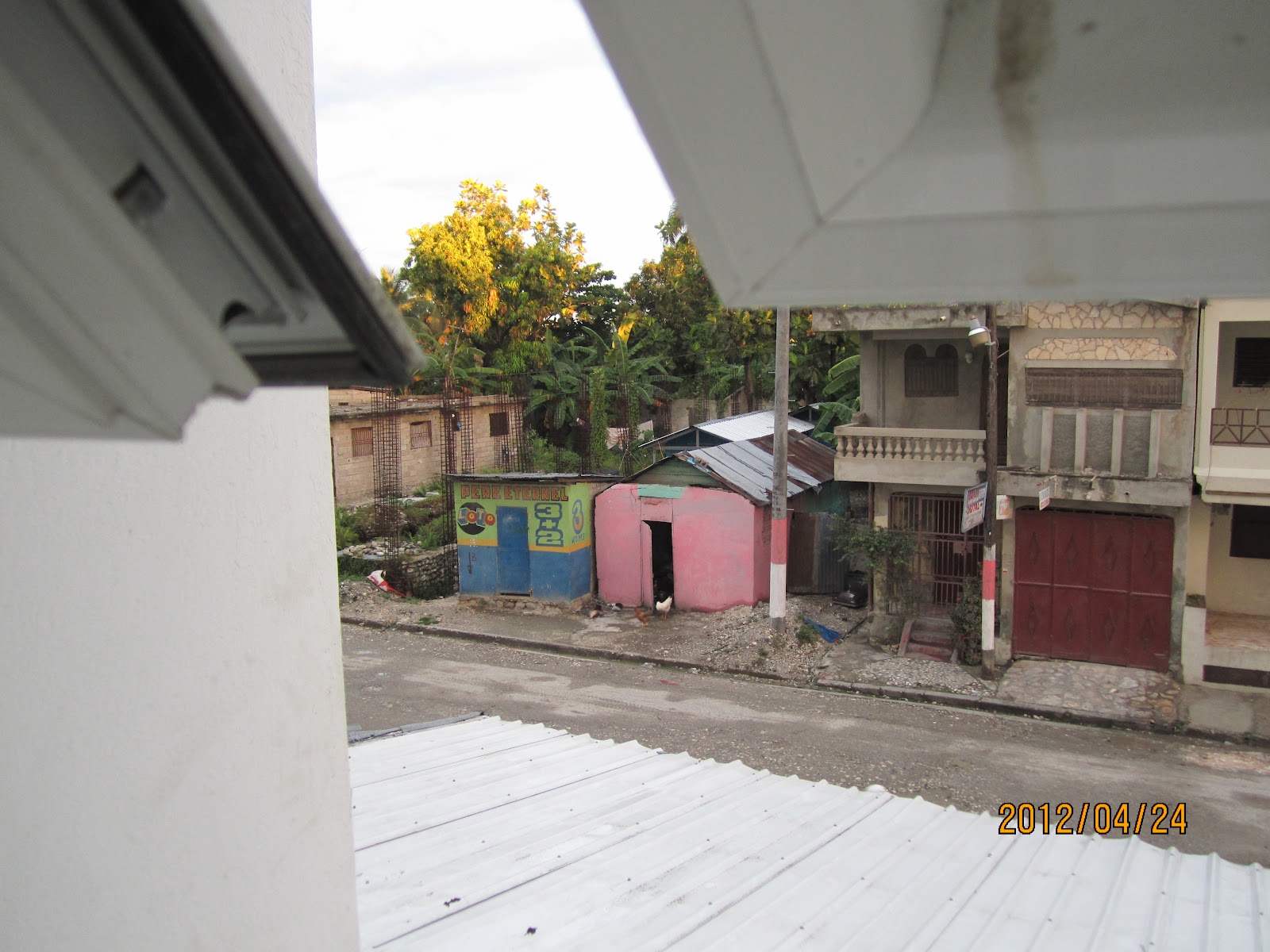
every thirty seconds until she chases him away. (He’s in attached photo 0712, at Madame Carmen’s front door.)
 |
| 712 |
Speaking of Madame Carmen, as you can see, the
lime-green house of last year is now pink – at least the front half. The painted on Christmas tree and ornaments are
gone. One thing remains though. Just like last year, every so often Madame
Carmen sits in her doorway, on her low riding chair, butt naked; like yesterday. (No photos attached.)
Dogs provide the evening sound
bites, while the roosters rest up for morning. I have yet to see an overweight dog in Haiti. They all look like they would rule any U.S. or
Canadian neighborhood, should they
somehow get transported to North America. The expression “street-wise” comes to mind when I watch Frankie’s dog
across the street.
Should you come to Leogane, and
take at least a fifteen minute walk around City Center or Belval, I promise you
will hear a number of children call out “Hey You !” Children and adults also may shout “blan” at
you. As a general rule, “blan” – which
is Kreyol for “white” or “whitie” when called out to a pale foreigner – is not
intended as a pleasant greeting. It’s
more like, “I see you in my neighborhood white person.” “Hey you” on the other hand can cut one of two
ways; as a friendly greeting of “Hey you, what’s up” or “Hey you, what are you doing
here.” I have learned ways to respond to
these shout outs. It doesn’t hurt to
know a fair amount of Kreyol. I’m
getting there.
A description of common street
happenings in Leogane would not be complete without a mention of “Ti Malice” –
which has at least three levels of meaning in Haiti. First, and foremost, “Ti Malice” is a brand
name for various cooking oils and food products. You can’t walk more than two blocks in
Leogane without seeing someone who is wearing a bright yellow t-shirt with “Ti
Malice” in blue on the front. I scored
one during Ra Ra. (Photo 0696)
 |
| 696 |
Frankie,
who owns a street level shop across the street, and lives upstairs, wears his
Ti Malice t-shirt and shorts 2-3 times a week. That’s him across the street in attached photo no. 0695, taken during a
school day uniform parade. Ti Malice was
a major sponsor of this year’s Ra Ra. One of the photographs I sent you with this year’s Note about Ra Ra was of a number of men on horseback with straw
hats. They all are wearing yellow Ti
Malice t-shirts under their blue sport coats.
Ti-Malice also is a popular Haitian
rock/reggae type band. And, Ti Malice is a noted Haitian
folklore character:
“Probably the most popular of the [folklore] characters are Uncle Bouki and his perpetual antagonist, Ti Malice. Bouki is ineffective, boastful, sometimes greedy, continually hungry, foolish, and often gently touching. Ti Malice is quick, conniving and ready to deceive either for an advantage or a joke. Together, Uncle Bouki and Ti Malice form a combination for plot and counterplot, usually funny, sometimes with a moral humor....As for Ti Malice, Haitians would roughly translate the name as meaning “mischief.” But the Ti in the name could well have come from “tio”, meaning “uncle” in Spanish.” Woody Woodpecker, Bugs Bunny and Roadrunner have nothing of you Ti Malice. Here, you win hands down the imaginary battle of the per capita t-shirts headcount.
RANDOM SIGHTINGS
In no particular order, I leave you with a list of some things that caught my attention when I worked around Leogane City Center, then up north of the Belval neighborhood where the Nursing College is located, out to the main Leogane – PaP highway, back down to Rue Lavandiere then west to Rue Pere Thevenot in front of the hospital, for about seventy-five minutes on Saturday one week past. Other sightings were made this past week.
The largest grey hair hog I have
ever seen, half submerged in a big mud pit. I thought it was dead until I saw a few bubbles come out of the snout. Three little drummer boys along the
side of a house – sharing a coffee can and plastic container to make street
beats.
Walking back with Watson from
Belval, after meeting with two of the nurses who were part of the hydroceles
surgery team operating at HSC last week. We were passing a huge public works ditch project near the old, now
demolished city hall, and approaching where the new Catholic Church will soon
be built. Watson said, “Leogane is
building.” Indeed it is.
Walking by the tent city next to
the large open air market in Belval. There are about half the number of tents I remember from this time last
year. I think this is a good sign. Perhaps some have moved into the new homes in
Santo.
The crowd watching the UEFA
Champions League soccer game between Barcelona and Chelsea, across the street
at Jackson’s. Leogane is a Futbol Club
of Barcelona town. Here the team is
simply called “Barsa” (as in “bar sah”). Chelsea knocked Barsa out of the semi-final round. Jackson’s was packed (photo 0714), as it also
had been a few days earlier for “El Classico”; which is the name given to any
match
between Spanish La Liga rivals Barsa and Real Madrid. Barsa also lost that game. It was not a good week for the crowds at Jackson’s. On top of the two loses within a span of a
few days, I don’t think more than 5 – 7 of the fans could actually see the T.V.
inside Jackson’s store.
Buying a grilled ear of corn for 10
gourdes from a woman vendor on the main Leogane-PaP highway. I’m not hesitant to eat local fare, within
reason.
Trash. Though it pales in comparison to the life and
death challenges some face, and I hesitate even to mention them, there are
mundane, small things around here that drive me nuts; for example the ubiquitous
litter of small plastic packets that once held about four ounces of drinking
water and discarded Styrofoam food containers.
Watching the hardest working men in
Leogane; those who pull huge wooden carts to tote at sorts of heavy items for their
customers. These are Haitian “teamsters”
so to speak, but without a Jimmy Hoffa legacy union or a decent wage to
compensate for the wear and tear endured by their bodies. (Photos 0724 and 0725)
 |
| 724 |
 |
| 725 |
At the beginning of my Saturday walkabout, I
was walking up Rue Pere Thevenot, and watched a barefoot man, who couldn’t have
weighed more than 110 lbs., struggle to pull a wooden cart loaded with at least
fifteen bags of cement and a few other bags. He was bent forward so much that his chin couldn’t have been more than
two feet from the ground. Amazing
strength, and lots of sweat.
I again visited the mass grave where many unidentified Leogane citizens are buried. he mass grave is located within the white
wooden fence line between the established cemetery at the end of Rue La Croix
and the main Leogane to PaP highway. (Photos 0705, 0706, and 0707)
 |
| 705 |
 |
| 706 |
 |
| 707 |
The sobering visit to the grave
site was followed immediately by a turn west on to Rue Lavandiere, where I came
upon the third of three Kleren stills I passed during the Saturday hike. (Photo
0708) Some Americans here refer to Kleren as
“Haitian sugar cane moonshine.” I think
that’s a misnomer. When I think of
moonshine, I think of a still hidden from “Revenuers” far back in an
Appalachian “holler.” Here, Kleren
stills are along well traveled roads, including one that is two blocks from the
hospital over on Rue Lavandiere.
 |
| 708 |
(Photo 0708)
I’m tried Kleren. It has such
high alcohol content that it starts evaporating as soon as it hits your
tongue. I’ll stick with Prestige Beer if
you don’t mind. But, I’ll ask my wife Jeanne to
give Kleren a try when she visits in a few weeks; so she can have yet another
memorable Haiti experience.
HOW IS YOUR FAMILY ?
When you are greeted by people you know, and even when meeting some strangers for the first time, it is not
uncommon to be asked, “How is your family?” Most asking this question are sincerely
interested in your answer. When I see
Dr. Bastien, the local dentist – as I did yesterday - he always asks me, “How
is your wife?”
Madame Bellevue and I start the
morning by asking each other how we slept last night. Last week, I also asked her about the
soreness in her right wrist. She no
longer is “fe mal,” which is good. I
learned Monday that over the weekend she had stopped the Advil I had given
her.
When I came back to the guesthouse
at the end of my Saturday hike a week past, Madame Bellevue opened the second
floor door for me. She was visiting with
one of her sons. Man was he tall – “wo”
in Kreyol. Madame stopped her
conversation with her oldest child to introduce him to me and to engage in several
minutes of conversation with me and her son even though she knew I wasn’t
following everything in Kreyol. It was
more important to take the time to chat than to have all words understood. How typical of Madame Bellevue, from whom I
have learned so much about nurturing relationships. My lessons from her began on my first day in Leogane
last year, March 30, 2011.
 |
| 294 |
Those of you who read last year’s
Notes have already seen the attached photo of Madame Bellevue (Photo
0294). I attach it again for the
newcomers, and to show all but one of the eight or so hats she has worn the
past month. Madame is a person of very
modest means. But, she is rich in grace
and every day radiates an infectious zest for life.
In the early evening, after 7:00
p.m. when moto traffic has subsided a bit, the pace on Rue Pere Thevenot
changes. Madame Carmen holds court with
passersby. Frankie and Jackson are out
front sweeping their porches but stopping often to talk with friends on foot,
bicycles and motos. Jackson’s grandson
is on his plastic tricycle, laughing quite a bit as he plays in front with one
of his parents or one of his 4 -6 years old neighborhood friends.They
sometimes taunt dogs roaming the street until a growl ends that mischievous play.
Evenings on Rue Pere Thevenot give
me a taste of what it would have been like to have grown up in a small town,
spending summer and fall evenings on the porch for an hour or two. Here, chickens and some goats roam the
neighborhood. No need for cages or
animal pens. Everyone knows who owns
each animal. But I guess this “hands
off” courtesy doesn’t always extend to cats.
During evenings at the hospital, Ty
Ty and Beelove are around. They both
live out back. They sit on the concrete
bench area outside the lobby and chat with friends, and with those bringing a
meal to a patient in the hospital. (There is no cafeteria at Hopital Sainte Croix as is the case with most
hospitals in Haiti.)
Last night I was outside under an
overhang next to the hospital main gate while it rained talking to one of the
translators about an American mobile clinic team due to arrive in 10 days. There was no rush to finish our
conversation. Cells phones were not
allowed to intrude.
When I’m in Leogane, I’m reminded
once again of the importance of talking to family and friends often and for
more than a few off-handed exchanges. To
me, the need to cement relationship bonds increases in direct proportion to the
ever accelerating pace of life in the United States. My conversational
skills improve when I’m here, because people expect you to ask about them and
their families, and for you to talk about yourself and your loved ones.
When he comes upstairs to see what
meds we might have in the guesthouse auxiliary pharmacy depot, I talk to Sammy
- the one who works in the O.R., not
Sammy the translator - about how Barsa in its last game. (I think this Sammy is a closet Real Madrid
fan.) I often talk politics with
Mario. We most recently discussed when the
UN troops might be leaving Haiti. When I
see Jo Jo each Monday and Wednesday for our “You teach me Kreyol, I’ll teach
you English” lessons, I ask about his three month old daughter, Betsy, and his
wife. He asks about Jeanne, and when
she’s coming to visit. It is not enough
to ask, “How are you today,” but that’s always a good start.
Most Thursdays or Fridays, I ask Ty
Ty about the church his band will be playing at the next Sunday/Dimanch service. Jeannine and I talk about her weekend
business. Last week, we printed up
business cards for Jeannine’s thriving catering business. In front of Jeannine about
two hours ago, I was singing the praises of her chocolate cake with a hint of
coconut to the volunteer manager of the
Filariasis Guesthouse in Belval. I’m
hoping that compliment will bring some of Jeannine’s homemade cookies to the
dinner table by the end of the week.
Mario and I have a running rock
trivia challenge carried over from last year. Just yesterday he came by to visit, and for some reason we drifted into
conversation about British soccer hooligans. Mario started laughing, and reminded me that last year he stumped me
when I couldn’t tell him which British rock band had cut the “Hooligans”
compilation album. It was The Who!
Greeting someone is not a
perfunctory experience in Haiti, if you let the give and take of initial
dialogue come to you and let it grab your undivided attention. Life slows down here for many
reasons, some good, some not so good. To
me, the best reason is the most refreshing – relationships truly matter.
I hope this Note finds you and your
loved ones in good health and spirits.
Peace,
David
02 May 2012
Tuesday, April 24, 2012
Notes From Leogane No. 20: Postscript
| Dear Family and Friends: |
This past Saturday I sent you No. 20 - Achte Pen - about lymphatic filariasis. Little did I know that two days later a team of American urological surgeons, anesthesiologists, and OR nurses would come to Hopital Sainte Croix to perform hydroceles surgeries. They performed four yesterday, and have five scheduled for today. They will be at HSC through Friday.
Most of the patients are men. Genital swelling from LF primarily affects men, but female genitalia also can become enlarged. In hydroceles surgery, fluid is drained from the impacted area, followed by surgical repair/reduction of the enlarged anatomical area. By the end of this week, 13-15 patients will have a new lease on life.
When I was reading about filariasis to prepare NFL 20, one article commented that in various parts of Haiti the mass drug administration ("MDA") efforts were not accepted by some because they believed the grotesque attack on people's bodies was from voudu or voodoo. (In Haiti, many don't even use this word to refer to this Haitian religious practice. Rather, it is called "following the loa" or "serving the loa".)
I thought it best not to include assertions about the "vodou" etiology of LF in the Note, because after all it was probably just the view of a few vodou followers. Then on Saturday we had three guests for dinner. One was the Haitian translator for the group. During dinner, I just happened to mention that on my way out of Haiti, as I did last year, I would be going next door to the LF clinic to get a six or seven pill anti-LF "super shot" to take the first day I arrived back in the States. This by the way is most probably an unnecessary precaution, because it would be a highly unlikely for a three months stay here to lead to LF infection.
One of the dinner guests was not familiar with filariasis, so I summarized for him the worms maturation process that causes the clogging of the lymphatic system. After my non-medical explanation, the translator guest spoke up. He said his younger twenty-eight year old sister had LF in her right leg. He indicated with his hands that the diameter of her leg was more than twice that of the other leg. He said it was vodou that got her when she walked out the front door one day and stepped on a piece of glass right foot. He said her leg ballooned up shortly after that. He was adamant that the slow, progressive development of microscopic filial larvae into adult worms had nothing to do with his sister's affliction. Now I have a better understanding for why some Haitians have not followed through with all 5-6 years of the MDA regimen. I hope it has not been too many.
I hope this postscript finds you and your loved ones in good health and spirits.
Peace,
David
24 April 2012
Saturday, April 21, 2012
Notes From Leogane No. 20: Achte Pen
Bourik swe pou chwal dekone ak dentel.
(Haitian proverb : The donkey
sweats so the horse can be decorated with lace.)
Si travay te be bagay, moun richla pran li lontan
(Haitian proverb : If work
were a good thing the rich would have grabbed it a long time ago.)
Dear Family and Friends:
I’ve heard more one than one
doctor down here say that lymphatic filariasis (“LF”) is a disease of poverty. My first note of this year
mentioned a number of things that have not changed since my first stay at
Hopital Sainte Croix (“HSC”):
“Some of the same street
vendors walk past my window each morning. I have yet to hear last year’s bread lady, who I remember calling out
“achte pen” (buy bread) about every 15 seconds. The parade of school children in ironed uniforms remains pretty much the
same. Patients still arrive outside the
locked entrance to the HSC outpatient clinic 1-1 ½ hours before it opens.”
I worry now that there is
more going on with the bread vendor than
her finding more customers on a street other than Rue Pere Thevenot on the
western edge of the hospital. I miss
watching this 5‘10” regal woman walk
by my office each day. She’s someone for
whom carrying a metal basket on her head, selling a loaf of bread for 10-15
gourdes (25-30 cents) to feed her family, was easily matched with a showing
of gracefully movement, almost.
This time last year she walked
with a slight limp in the right leg. A year ago, you could tell she was
afflicted with the early manifestations of LF. I fear this dreadful disease now has progressed to the point where it is
extremely difficult for her to walk. The cause of lymphatic
filariasis is not pleasant to contemplate. Lymphatic filariasis can
result in an altered lymphatic system and the abnormal enlargement of body
parts causing pain and severe disability.
* * *
Lymphatic filariasis,
commonly known as elephantiasis, is a neglected tropical disease. Infection occurs when filarial parasites are
transmitted to humans through mosquitoes. When a mosquito with infective stage larvae bites a person, the
parasites are deposited on the person’s skin from where they enter the
body. The larvae then migrate to the
lymphatic vessels where they develop into adult worms in the human lymphatic
system. Infection is usually acquired
in childhood, but the painful and profoundly disfiguring visible manifestations
of the disease occur later in life. Whereas acute episodes of the disease cause temporary disability,
lymphatic filariasis leads to permanent disability.
The attached photograph of a
woman in Leogane, with bilateral lower extremity LF, provides but one example
of the grotesque ballooning of the limbs and genitals associated with this
dreadful disease. For males, the disease
often manifests itself with enlarged testicles/scrotum. Soon after I arrived in Leogane last year, I
was walking to Belval with an American who had been living in Leogane for more
than a year. When the subject of
filariasis somehow came up, I was asked if I had seen “the wheelbarrow
man.” I had not. I’m now told that he received hydroceles
surgery, to drain fluid and dramatically reduce the size of his genitals.
It is not my purpose here to
overwhelm your thoughts with images of the victims of LF. But, you cannot fully appreciate the
challenges of life in Haiti, and other impoverished tropical environments,
without a candid discussion of the ravages of lymphatic filariasis. The images you may be contemplating right now
may be tempered somewhat by a brief report on the progress being made in the
fight against LF, particularly in Leogane.
In Leogane, “the percentage
of residents testing positive for the young [LF] parasites plunged from 30% in
1995 to 5% in 2005.” (ND Newswire, The
priest and the parasite, University of Notre Dame, June 06, 2005). The ND Newswire article acquaints the reader
with Father Tom Streit, a Catholic Holy Cross priest who now has been living in
Haiti for more than fifteen years. (Photo of Fr. Streit attached)
The Filariasis Clinic he
founded is supported by various organizations, primarily the University of
Notre Dame, the Centers for Disease Control (“CDC”), Hopital Sainte Croix and
the Haitian Health Ministry with grant funds from the Bill and Belinda Gates
Foundation. The clinic is next
door.
The importance of this clinic
was first brought home to me last year, the day before I left Leogane to return
to Arizona. I went next door to say
goodbye to an American volunteer at the clinic. During my visit, I was told that the 20-25 men in the waiting room were
there for follow-up visits after they all had undergone successful hydroceles
surgery.
The dramatic drop in the
rates of LF infection among the citizens of Leogane Communale (“Leogane
Region”) is attributable to an aggressive mass drug administration (“MDA”)
program initiated by Notre Dame/CDC/Ste. Croix
under the auspices of the Filariasis Clinic. Studies here and at the World Health
Organization (“WHO”) have determined that “MDA should be continued for 4-6
years to fully interrupt transmission of the infection.”
By 2010, worldwide
“thirty-seven endemic countries had already completed five or more rounds of
MDA in at least some of the endemic areas. From 2000-2010, more than 3.4 billion treatments were delivered to a
targeted population of about 900 million individuals in 53 countries, considerably
reducing transmission in many places.” (Lymphatic
filariasis , WHO Media Centre Fact Sheet No. 102, January 2012.)
While it is much harder to
reverse the damage from advance stage LF, it is preventable. “[I]n 1997, . . . the World Health
Organization named filariasis among several diseases able to be
eradicated. WHO’s target date to
complete eradication is 2022.” (ND
Newswire) Until its worldwide defeat, LF
will remain a disease of the poor; unquestionably so in Haiti.
“The majority of the worst
cases are among poor Haitians, who are unlikely to visit a doctor. Others are too ashamed to appear in
public.” Father Steit is blunt in his
assessment:
“I challenge people to come
up with another disease so tied to poverty. You look at the world where it exists and there is always horrible poverty.” (ND Newswire)
I have a more basic take on
the tie between poverty and lymphatic filariasis. When Watson and I, and the moto driver,
hopped on one moto this past Tuesday, we took a short cut, rather than the
paved highway back toward Santo, which would then have required another two
miles on a dirt road.
The short cut took us by many
temporary shelters and tents in Santo. Many of these tents were vacated by the new homeowners who moved into
the Habitat and Haven built houses in January 2012. There had been an absolute downpour for about
two hours Monday night. Tuesday morning there was standing water everywhere. I
could see where people had shoved water out the door of their shelters and
tents. I was reminded of another
trip to a tent city, last April 2011. Then, I walked up to the largest open air market in Leogane City Center
looking for a used tie to wear at the Easter service next door. The half circle road, along which tarps and
blankets were placed on the ground for the display of items for sale, served as
a border for the largest tent city I have yet to see in Leogane City
Center. The tents were located in a
depression below the grade of the road. The berm of the road would keep water from flowing away from the tents
during and after a downpour.
I returned by moto to the
guesthouse with my used tie in hand. A few hours later, the skies open up. As I enjoyed the sights and sounds of this
cleansing rain, I stopped to think about the families in the tent city next to
the market, and other tents in Leogane, because I already had been told that
during major downpours many parents have to pick up and hold infants to keep
them out of the standing water.
My simple lesson learned is
that the more resources one has the
higher one’s home, both in terms of locating a house above low lying areas and
being able to afford an elevated foundation that sits above expected flood
levels such as the new houses in Santo. Pockets of standing water
provide breeding grounds and living quarters for moustik.
I fear that today you may
feel I’m painting too gloomy of a picture. That is not my intent. The
efforts of Father Streit, Notre Dame, CDC and Hopital Sainte Croix are good
works of hope and promise.
Another story of improvement
is being played out today at the hospital clinic downstairs while I type this
note. The clinic usually is closed on
Saturdays. But today 1-5 year-olds
from all over the Leogane Communale are here to receive their vaccinations
from the Haitian Ministry of Health.
“The wealth of the rich is their fortress; the poverty of the poor is
their ruin.” Proverbs 10:15
I hope this note finds you
and your family in good health and spirits.
Peace,
David
21 April 2012

You can't see the right leg of my favorite bread vendor in the attached photograph (0801).
I'm happy to report that while madame still has a slight limb, I didn't see any increase in the size of her right leg since I last saw this woman in late June 2011.
I may have been mistaken last year when I assumed this woman was in the early manifestation stages of lower extremity lymphatic filariasis. I hope so.
Peace,
David
May 12
Second Postscript
About
fifteen minutes ago, I heard a familiar voice say "achte pen" outside
my window for this first time since I arrived in Leogane on March 30, 2012.

You can't see the right leg of my favorite bread vendor in the attached photograph (0801).
I'm happy to report that while madame still has a slight limb, I didn't see any increase in the size of her right leg since I last saw this woman in late June 2011.
I may have been mistaken last year when I assumed this woman was in the early manifestation stages of lower extremity lymphatic filariasis. I hope so.
Peace,
David
12 May 2012
Saturday, April 14, 2012
Notes From Leogane No. 19: Holy Week and Cange
Dear Family
and Friends:
The martyred
Salvadoran Catholic bishop Oscar Romero once said:
“This is
what we are about. We plant the seeds
that one day will grow. We water seeds
already planted, knowing that they hold future promise. We lay foundations that will need further
development. We provide yeast that
produces effects beyond our capabilities. We cannot do everything and there is a sense of liberation in realizing
that. This enables us to do something
and to do it very well. It may be
incomplete, but it is a beginning, a step along the way, and opportunity for
the Lord’s grace to enter and do the rest.”
In this
Note, I’d like to work backwards during the days of Holy Week, to arrive at
Cange on Palm Sunday, where seeds of promise were planted almost thirty years
ago.
Easter Sunday Service at Paroisse Sainte Croix - Eglise Episcopale D'Haiti
I attended
Easter Sunday service next door at the Episcopal church. The new church remains the same – a concrete
pad, a corrugated metal roof supported by wood cross beams and vertical wood support
posts. The church remains an open air
meeting place. The ruins of the old church are about 100 feet back of the
altar. As you sit in a pew, the remnants
of the vertical and horizontal concrete beams of the destroyed church invite
your mind to wander, to see unintended massive crosses as backdrop for the
service. Easter
service this year was but two hours and forty minutes long, a bit of a reprieve
from last year’s three hours marathon.
Pere Kerwin
Delicat still is the Rector. I met with
him this past Thursday, to discuss a commitment by St. Anthony on the Desert
Episcopal Church in Scottsdale to assist the Episcopal school. (I’m proud of my church’s support of Paroisse
Ste. Croix.) During our meeting, I
learned from Pere Kerwin that all of the church service presented through him
and other religious, from the opening
prayer through communion, is said in French.
Hymns alternate between French and Kreyol. Pere Kerwin and the Deacon
switch entirely to Kreyol during
announcements and the community meeting - about forty-five minutes long
- at the end of the service, followed lastly by the benediction in French.
The
“communal soul” of the people of this church, described last April in Note No.
3, was ever present last Sunday. Sunday
strikes me as a day for the congregation, individually and as church body, to
leave behind for a few hours the hard life for many of the past week and the
week to come in Leogane, Port-au-Prince
and elsewhere, to share a common bond with all of their brothers and sisters, whatever
his or her station in life. They offer
up their faith and look to receive spiritual nourishment.
In last
year’s note about Episcopal Paroisse Sainte Croix, I acquainted you with all of
the choirs that give such uplifting character to Sunday services. The adult choir (“Chorale des adultes”) still
performs as does the children’s choir (“Chorale des enfants”). The “twenty-somethings” choir of last year –
four women and a man accompanied by a single acoustical guitar – was replaced, at least on this Easter
Sunday, by “Groupe Phylantrope.” The
four men, all in their twenties, were dressed in black from head to foot. The electric guitarist also was the lead
singer. The congregation seemed to enjoy
this singing group; there was polite applause after each of their songs. But it is obvious that “Groupe Choeur des
Anges” continue from last year as the musical stars at this parish.
Indeed, the
cover of the program distributed before Easter service noted that the Easter
Sunday service was commemorating the anniversary of the Choir of Angels. Last year in Note 3, I called this group of
seven young women the “purples/whites” – because I was unaided by a program to
see their proper name: “Each wore a
white suit top with purple stripes and a matching white skirt, also with
purples stripes.” This description came
from a regular service I attended a few weeks before Easter.
At Sunday’s Easter
service, the Choir of Angels wore the same light beige dresses, with green and
blue trim on the neckline and short sleeves, they wore at last year’s Easter
service. The same stellar voices rose
high last Sunday, but this year there was a new lead singer who shared lead
vocalist responsibilities last year’s veteran.
I observed a bit of polite
friction between the seasoned veteran and her younger colleague when they
engaged in a “private discussion” outside the church during the offertory,
before their last hymn during communion.
(My ease dropping was aided by the open air sides of the church.)
I now have
attended three services at Paroisse Ste. Croix.
At each, right before anouncements, Pere Kerwin has motioned for
everyone to stand, look up, wave toward the sky, and say loudly, in Kreyol,
“Bonjou Seye.” Each time, Pere has asked
for the greeting to God be repeated and to be louder. After success on the second or third try, he
moves on to the next wave and shout out, “Mesi Seye.”
I wonder how
I would react were I to attend a religious service in Arizona and, rather than
ending with a demurred closing prayer or benediction, the priest, minister,
rabbi or other religious told us to jump to our feet and shout toward the
sky: “Hello God” followed by “Thank You
God”, two or three times each until we got it right. I must confess, my effort this past Sunday
failed to meet Pere Kerwin’s standards.
A Good Friday Procession Revisited
I will not
dwell on last Friday’s Good Friday procession, from the Catholic church Sainte
Rose de Lima, which passed by the hospital on Rue Pere Thevernot heading for
Rue La Croix. It already has been the
subject on a brief note, No. 17. But,
the photographs I sent you last Friday do not do justice to that religious
observance, because those photos were taken at ground level. For that reason, I’m including a few of the
procession photos from last year’s Catholic Good Friday procession.
Offerings at Palm Sunday Service in Cagne
On Palm
Sunday, half of the Michigan mobile clinic group staying at the HSC Guesthouse
attended the Episcopal service next door. They missed falling into the back of the procession as it passed
underneath my office window – one laggard was still combing hair - but they all
were in the wooden pews before Pere Kerwin, the Deacon, acolytes, and about
fifty parishioners arrived at the church. Michigan John told me after the service that an usher showed him a good
seat up front. But, he no sooner had
settled in for the 150+ minutes service when the usher returned with a well-dressed
elderly woman, in an Easter hat. With
hand signals, the usher directed John to squeeze in next to his friend Tom a
few rows back. Age and church tenure
does have its advantages, particularly when the interloper in your usual spot
is only in town for a week.
The other
half of the Michigan crowd traveled to Cagne in a van driven by the Dean of the
Episcopal Nursing College, Hilda Alcindor.They started a bit late, but made the 2 ½ hour drive northeast of
Port-au-Prince, arriving in time for the beginning of the 10 a.m. service. They arrived
back her about 3:00 p.m.
 |
| Original Church |
Upon his
return, Michigan Fred, who is in his seventies, said that the Palm Sunday service
in Cange was one of the ten most memorable experiences of his life; because of the offering. He and his colleagues had learned from Dean
Hilda during the drive up that this event has been repeated for several years
on Palm Sunday at the church in Cagne.
The Palm
Sunday service does not have your ordinary collection. Ushers
do not pass a wooden plate, for the offering of weekly tithing envelopes,
checks, currency or coins. No, the
offering is a lengthy processional down the aisle, with music, starting with
the youngest members in attendance. First came rolls of toilet paper, balanced on the heads of young boys and
girls. Next, mangoes, papaya, other
fruits and various vegetables. Loaves of
pen (bread) were included. Men carried
over their shoulders sacks of beans and diri (rice).
This was not
a somber walk down the aisle. Music
accompanied all of the offerings. Women
were the most active dancers as they carried their gifts to the foot of the
altar. One of the
Michigan worshipers began laughing as she talked about the woman carrying some
food stuffs, who stopped dancing down the aisle when the music stopped. She glared back at the band, and waited for
more music before continuing her samba steps to the altar. Beer and
wine, and various fruit drinks and sodas were brought forth.
I’m not
sure, but I think someone told me that the offering included various linens,
towels and cloth napkins, but I’m not sure. But I’m positive what I heard about the last part of offering. A number of the Michigan folks said tears
welled up about this time. Live
chickens, goats, pigs and cows were brought down the aisle to the front of the
church. A sight that none of the
Michigan folks had ever seen, and may never see again. I sure haven’t been fortunate enough to
witness this kind of outpouring of giving during a church service in Haiti.
I visited
with Haiti veteran/Indiana native Missy Owen a few days later about the Cagne
service. (You’ll recall mention of Missy in Note No. 15 last year.) She explained that the Palm Sunday service in
Cagne comes during a harvest period in Haiti. The offering is made to support the
religious and church staff. But, what is
left after the church’s share is taken is given back to the community; after a
luncheon (manje midi) celebration is held after the service where parts of the
offering are eaten.
Paul Farmer and Partners in Health
Before I returned
to Haiti last year for my first three months stay in Leogane, had you mentioned “Cagne” to
me, I would have never thought about the Palm Sunday service there. I only heard about this intriguing event from
the descriptions of two weeks ago.
After
reading a few years ago “Mountains Beyond Mountains,” I only associated Cagne
with Dr. Paul Farmer and the non-profit medical organization Zanmi Lasante (Partners
In Health / PIH). There is not
enough space here to properly cover how much Dr. Farmer and PIH have meant, and
still mean, to the delivery of much needed medical care in Cagne and other
villages in the Central Plateau region of Haiti. I would start by saying that Paul Farmer is recognized
worldwide as an authority on infectious diseases, and a learned
anthropologist. He is Harvard Medical
School trained. His work has included
the treatment of Multi-Drug Resistant (“MDR”) tuberculosis, not only in Haiti
but in the slums of Peru and prisons of Russia.
 |
| Dr. Paul Farmer |
“Mountains Beyond Mountains” provides an excellent
first read for anyone who is interested in learning more about this amazing doctor
and humanitarian.
The
Introduction to the book explains that the title is based on a Haitian metaphor
for life’s challenges: “Once you have
scaled one mountain, you reach a place where you can see that there are always
more mountains farther away; you will never stop climbing, never be finished.”
Those
associated with the original church and first clinic in Cange undoubtedly were
challenged both physical and metaphorical mountains beyond mountains, before
they arrived at a point where their vision beyond many difficult climbs became one
of the premier social, economic, educational and medical complexes in a third
world country. They succeeded in
following Bishop’s Romero’s ideal of laying foundations for further
development, to produce effects far beyond what others may have expected.
Modest Beginnings Leading to Dramatic Impacts
Cange is one
of the poorest regions in Haiti, because of the hydroelectric dam built on the
Artibonite River in 1956. After this power project flooded the main
fertile area of the valley, the people of Cange were pushed up onto rocky
hillsides with very little farm able land.
In 1962,
Father Lafontant and his wife, Yolande, established a primary school in
Cange. Many of the students didn’t reach
adulthood – infectious diseases killed almost one-quarter of all of their
students
 |
| Father LaFontant |
In 1983, just
after being accepted to Harvard Medical School, Paul Farmer came to Cange for
the first time. With the support of Father
Lafontant, the Episcopal Church in Haiti and the U.S., and Boston businessman
Tom White, the Clinique Bon Sauveur was established in Cange in 1985.
Zanmi
Lasante/PIH was founded in 1987 by Paul Farmer, its founding director, Tom
White, Harvard medical student Jim Yong
Kim–then a Harvard medical student, and others. (I include here now Dr. Jim Yong Kim not only
because of his role in the founding of PIH,
but also because, of interest, recently President Barak Obama nominated
Dr. Kim as President of the World Bank.)
Twenty-four
years later, Partners In Health has reported on its work in Haiti during
FY2011:
- 2.8 million patient encounters
- 13,784 children received educational assistance
- 6,268 HIV-positive on treatment
- 98,735 pregnant women seen in antenatal clinics
- 53 houses constructed or repaired
- 482 TB patients treated
- 75,000 cholera patients treated.
Partners In
Health also recently reported that in the two years after the January 12, 2010
massive earthquake, PIH registered 4.6 million patient encounters. These
statistics unquestionable underscore the incredible work of Zanmi Lasante for
the people of the Central Plateau. But
this recounting of the importance of PIH to the delivery of essential health
care in and around Cange serves as a grave reminder that Haitian public health
services and private Haitian hospitals and clinics are ill prepared at this
time to go it alone and meet the health needs of its more impoverished citizens.
In the
Central Plateau, the PIH clinic in Cange now has is a sliding scale fee
clinic.The less money you have, the
less you pay for medical services. Elsewhere in Haiti, for example at various hospitals and clinics in
Port-au-Prince and Cap Hatien in the north, medical care may be denied to patients
unable to pay the medical provider’s usual charges.
This is not
the case at Hopital Sainte Croix in Leogane. Only modest fees are paid. And,
depending on the needs of the patient and availability, medications are
provided at little or no cost. HSC is
the indigent care hospital in the Leogane Region.
From my
experiences here last year and this past month, I would venture to say that Hopital
Sainte Croix is moving forward to significantly expand the scope of health
services in the Leogane Region. In
2011, a number of additional medical
specialties are returning or are planned for return in the near future: OB/GYN, ophthalmology, urology, sonography,
endoscopy, colonoscopy, an eye clinic and a dental clinic. I sincerely believe that eventually, in the
not too distant future, this hospital will return to its position as a state of
the art and point of reference in Haiti for both its out-patient
clinic and in-patient hospital.
I hope this
note finds you and your loved ones in good health and spirits.
Peace,
David
14 April
2012
Subscribe to:
Posts (Atom)